

Tanzania Self-Drive Safari: Calving Season vs Mara River Migration
Tanzania Self Drive | Tanzania 4×4 Car Rental | Serengeti Self Drive | Wildebeest Migration Tanzania | Ndutu Safari | Kogatende Safari | Mara River Crossing
Tanzania is one of the best destinations in Africa for an independent self-drive safari. With a reliable 4×4 vehicle, careful planning and enough time, travellers can explore the Serengeti, Ngorongoro, Tarangire and other wildlife areas without joining a traditional guided safari.
For travellers planning around the Wildebeest Migration Tanzania, however, choosing the right season is critical.
The two most famous migration periods are the January–February calving season in Ndutu and the July–September Mara River crossing season in northern Serengeti.
Both are spectacular. But if you are hiring a 4×4 for a self-drive safari, they offer very different experiences.
So which should you choose?
Calving season or Mara River migration?
Let’s compare them.
Quick Comparison: Ndutu vs Kogatende
| Ndutu Calving Season | Kogatende Mara River Season | |
|---|---|---|
| Best months | January–February | July–September |
| Region | Southern Serengeti / Ndutu | Northern Serengeti |
| Main attraction | Newborn wildebeest | River crossings |
| Predator action | Exceptional | Excellent |
| Herd concentration | Very high | Very high |
| River crossings | No | Possible |
| Self-drive | Excellent | Excellent with preparation |
| Roads | Variable | Remote and rough |
| Crowds | Moderate | Higher during crossings |
| Recommended stay | 3–5 nights | 3–5 nights |
| Best for | Photography & predators | Dramatic migration action |
Tanzania Self-Drive Safari During Calving Season
If you want to see the Great Migration at a time when wildlife activity is exceptionally concentrated, January and February are excellent months to visit Tanzania.
The migration moves into the short-grass plains of the southern Serengeti and Ndutu area.
This is where thousands of wildebeest give birth.
The result is an extraordinary wildlife spectacle.
Within a relatively short period, the plains can be filled with newborn calves, mothers, large herds of wildebeest, zebra and gazelle.
And where there are large numbers of young animals, predators are never far away.
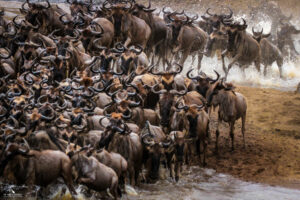
Why Choose Ndutu?
A Ndutu self-drive safari is ideal for travellers who want to spend several days following wildlife rather than simply ticking off destinations.
The area is famous for its open plains and seasonal concentration of wildlife.
During the calving period, you may encounter:
- Newborn wildebeest
- Large wildebeest herds
- Zebra
- Gazelles
- Lions
- Cheetahs
- Hyenas
- Jackals
- Raptors
- Other Serengeti predators and wildlife
For photographers, the combination of newborn animals and predators creates outstanding opportunities.
You can spend an entire morning following a herd, return to the same area later in the day and continue watching the wildlife without being tied to a fixed guided-safari schedule.
That’s one of the biggest advantages of a Serengeti self-drive.
February: One of the Best Months for Serengeti Self Drive
February is particularly attractive for travellers who want a combination of:
Wildlife + migration + predators + photography + flexibility.
The landscapes can be green following seasonal rains, creating beautiful scenery.
The open plains also make wildlife easier to spot in many areas.
For a self-drive traveller, February offers another important advantage:
You are not depending on a single event.
The calving period lasts for weeks.
You don’t have to arrive on one specific day and hope that something happens.
The animals are already there.
Tanzania Self-Drive Safari During Mara River Migration
If your dream is to witness the famous Mara River crossing, your strategy changes completely.
The migration moves north during the dry season, with large numbers of wildebeest reaching northern Serengeti.
The Kogatende area is one of the most important bases for travellers targeting the northern migration.
A successful crossing can be one of the most dramatic wildlife experiences in Africa.
Large herds gather around the river.
The animals hesitate.
Some may enter the water.
Others turn back.
Eventually, a group may suddenly rush into the river.
The crossing can happen incredibly quickly.
The Reality of a Mara River Crossing Safari
There is one thing every traveller needs to understand:
A Mara River crossing is never guaranteed.
Even during the peak migration months, there is no timetable saying:
“The wildebeest will cross at 10:00 tomorrow morning.”
Wild animals do not follow human schedules.
The herds may remain near the river for hours or days.
They may move away.
They may cross somewhere else.
They may cross shortly before you arrive.
Or they may cross while you are watching.
This uncertainty is part of what makes the migration so fascinating.
How Long Should You Stay in Kogatende?
If the Mara River crossing is your main objective, avoid planning only one night in northern Serengeti.
Instead, consider staying:
3–5 nights around Northern Serengeti
This gives you multiple mornings and afternoons to search different areas and monitor the movement of the herds.
A longer stay does not guarantee a crossing, but it gives you more opportunities.
This is particularly important for Kogatende self-drive travellers because the northern Serengeti is a large and remote area.
Kogatende Self Drive: What You Need to Know
Northern Serengeti is considerably more remote than the areas around Arusha and Karatu.
You should be prepared for:
- Long distances
- Rough tracks
- Dust
- Corrugations
- Limited services
- Limited fuel availability
- Changing weather
- Difficult navigation
- Remote camping
This is why choosing the right Tanzania 4×4 car rental is extremely important.
A standard city SUV is not the same as a properly equipped safari 4×4.
Why a Toyota Land Cruiser Is Recommended
For serious Tanzania self-drive safari trips, a Toyota Land Cruiser is one of the preferred vehicle types.
The vehicle should ideally have:
- Genuine 4WD
- High ground clearance
- Reliable suspension
- Strong tyres
- Spare wheels
- Recovery equipment
- Adequate luggage space
- Good fuel range
- Camping equipment if required
For longer camping journeys, a rooftop tent can also be added.
A properly equipped Land Cruiser 4×4 rental gives you the confidence to travel deeper into Tanzania’s wildlife areas.
Self-Drive Calving Safari Route
A popular route for a Ndutu self-drive safari can look like this:
Day 1 – Arusha to Tarangire
Begin your journey with a game drive in Tarangire National Park.
Day 2 – Tarangire to Karatu
Continue toward the Ngorongoro Highlands.
Day 3 – Karatu to Ndutu
Enter the southern Serengeti and begin looking for the migration.
Day 4 – Ndutu
Full-day wildlife exploration.
Day 5 – Ndutu
Another full day focusing on wildebeest and predators.
Day 6 – Ndutu to Central Serengeti
Drive north through the Serengeti ecosystem.
Day 7 – Central Serengeti
Full-day game drive.
Day 8 – Serengeti to Arusha
Return to Arusha.
This itinerary can be shortened or extended depending on your flight schedule and safari priorities.
Self-Drive Mara River Safari Route
For a Mara River crossing safari, a longer route is recommended.
Day 1 – Arusha to Central Serengeti
Long driving day toward the Serengeti.
Day 2 – Central Serengeti to Kogatende
Continue north toward the migration.
Day 3 – Kogatende
Search for herds and monitor river activity.
Day 4 – Kogatende
Full-day Mara River migration safari.
Day 5 – Kogatende
Another full day in northern Serengeti.
Day 6 – Kogatende to Central Serengeti
Begin the journey south.
Day 7 – Serengeti to Ngorongoro
Game drive en route.
Day 8 – Ngorongoro to Arusha
Finish the safari.
If you have additional time, adding another night or two in Kogatende is even better.
Calving Season vs Mara River: Which Has More Predators?
Both seasons can produce excellent predator sightings, but the nature of the experience differs.
During calving season, newborn animals create a natural concentration of prey.
This can attract lions, cheetahs and hyenas.
The open southern plains can also provide excellent visibility.
During the northern migration, predators remain active around the large herds.
Lions, leopards, cheetahs and hyenas can all be encountered.
However, the Mara River experience is more about the dramatic interaction between the river, herds and predators.
Which Season Is Better for Photographers?
Calving Season
Choose Ndutu if you want:
- Newborn calves
- Mother-and-calf photographs
- Predator hunts
- Green landscapes
- Large herds
- Wide-angle landscape photography
Mara River Season
Choose northern Serengeti if you want:
- River crossings
- Dust
- Huge herds
- Dramatic action
- Crocodiles
- Animals entering and leaving the river
For action photography, a Mara River crossing can be extraordinary.
For a broader wildlife photography experience, however, calving season can be easier to work with because wildlife activity is more continuous.
Which Is Better for First-Time Self-Drive Travellers?
For someone doing their first Tanzania self-drive safari, calving season can be the easier choice.
Why?
Because the migration is concentrated around the southern Serengeti and Ndutu area, and you can build a relatively straightforward route through Tarangire, Ngorongoro and Serengeti.
The northern Serengeti requires additional driving and more detailed logistics.
If you are experienced with remote 4×4 travel and specifically want the Mara River crossing, northern Serengeti is absolutely worth considering.
What About Camping?
A Tanzania camping safari is an excellent way to experience the migration.
A 4×4 with a rooftop tent gives you the flexibility to stay close to the areas you want to explore.
A typical rental package can include:
- Toyota Land Cruiser 4×4
- Rooftop tent
- Mattress
- Sleeping bags
- Camping chairs
- Camping table
- Cooking equipment
- Kitchen utensils
- Fridge or cooler
- Recovery equipment
- Spare tyres
Camping also allows travellers to create a more flexible itinerary.
However, all camping inside protected areas must follow the applicable park regulations and designated campsite requirements.
What Should You Pack for a Tanzania Self-Drive Safari?
For a migration-focused self-drive trip, we recommend carrying:
Vehicle essentials
- Valid driving licence
- Navigation device or offline maps
- Spare tyres
- Basic recovery equipment
- Tyre-pressure equipment
- Torch/headlamp
- Emergency supplies
Safari equipment
- Binoculars
- Camera
- Long telephoto lens
- Extra batteries
- Power banks
- Dust protection for cameras
- Sun protection
- Warm clothing for early mornings
Camping equipment
If renting a fully equipped vehicle, most major camping equipment can be supplied with the vehicle.
Fuel and Remote Driving
One of the biggest differences between an ordinary road trip and a Serengeti self-drive is fuel planning.
You should not assume that fuel is available everywhere.
Before entering remote areas, fill the vehicle and calculate the approximate distance to your next reliable fuel point.
This is particularly important when travelling toward northern Serengeti and Kogatende.
A vehicle with a good fuel range is a major advantage.
How Much Does Tanzania 4×4 Car Rental Cost?
The price of a Tanzania 4×4 car rental depends on several factors:
- Vehicle type
- Number of rental days
- Season
- Camping equipment
- Insurance
- Pickup location
- Drop-off location
- One-way rental
- Cross-border requirements
- Additional equipment
Longer rentals can often provide better value per day.
For a personalized quotation, provide:
Travel dates + number of travellers + pickup location + drop-off location + self-drive or driver + camping requirements.
We can then recommend the most suitable vehicle and equipment.
Can I Combine Serengeti With Other Tanzania Parks?
Absolutely.
One of the biggest advantages of a self-drive trip is the ability to create a multi-park route.
Popular combinations include:
Northern Tanzania Classic
Arusha → Tarangire → Ngorongoro → Serengeti
Migration Self Drive
Arusha → Ngorongoro → Ndutu → Central Serengeti
Northern Migration
Arusha → Central Serengeti → Kogatende → Central Serengeti → Ngorongoro
Longer Tanzania Road Trip
Arusha → Tarangire → Ngorongoro → Serengeti → Lake Eyasi → Lake Manyara → Arusha
The best route depends on the season and the wildlife you want to see.
Our Recommendation: February or August?
If you are choosing between the two specifically for a Tanzania self-drive safari, consider your priorities.
Choose February if:
Your priority is wildlife.
You want newborn animals, predators, large herds and excellent photography.
Choose August or September if:
Your priority is the migration spectacle.
You specifically want to try to witness the Mara River crossing.
Choose neither if:
You only have one or two days in the Serengeti.
A migration-focused trip deserves enough time to account for animal movements and changing conditions.
Book Your Tanzania Self-Drive 4×4
Ready to explore Tanzania independently?
Pendo La Africa Safaris provides Tanzania 4×4 car rental for travellers planning self-drive safaris, camping adventures and longer East African road trips.
We can help you arrange a suitable safari vehicle for:
- Serengeti self-drive
- Ndutu calving season
- Kogatende migration
- Mara River crossing safari
- Ngorongoro
- Tarangire
- Lake Manyara
- Northern Tanzania
- Tanzania camping safari
- Tanzania and Kenya road trips
- Tanzania, Kenya and Rwanda adventures
Whether you want to photograph newborn wildebeest in Ndutu or follow the migration toward Kogatende, the right vehicle and route can make a major difference.
Start Planning Your Tanzania Self-Drive Safari
Tell us:
Your travel dates
Number of travellers
Pickup location
Drop-off location
Self-drive or driver
Camping or accommodation
Your main migration objective
We will help you plan the right Tanzania self-drive safari and recommend a suitable 4×4 rental vehicle for your route.
Calving Season or Mara River?
Ndutu for new life.
Kogatende for dramatic river crossings.
Tanzania for the ultimate self-drive safari adventure.